

Foreword
Recently, Huma Finance allocated a large number of airdrops to Kaito Yappers and $KAITO stakers, once again sparking a wave of InfoFi enthusiasm. Riding on this momentum, Cookie.fun and Galxe Starboard successively emerged within a week, officially joining the competition of InfoFi platforms, seemingly forming a tripartite rivalry with Kaito.
But compared to Kaito, what are the respective features and advantages of Cookie.fun and Galxe Starboard? And what opportunities are there for participation? This article will summarize detailed information on both, introduce currently available activities, and compare them with Kaito.
The Past and Present of Cookie.fun
Cookie.fun is an instant data dashboard launched by Cookie DAO, an AI-driven modular data layer. Originally, it was only used to track AI Agent-related token information, market sentiment, and social media tweets. However, following the recent wave of InfoFi, Cookie.fun expanded its dataset and established a new "Social" panel, integrating information on over 10,000 tokens and projects, going beyond just AI Agents.
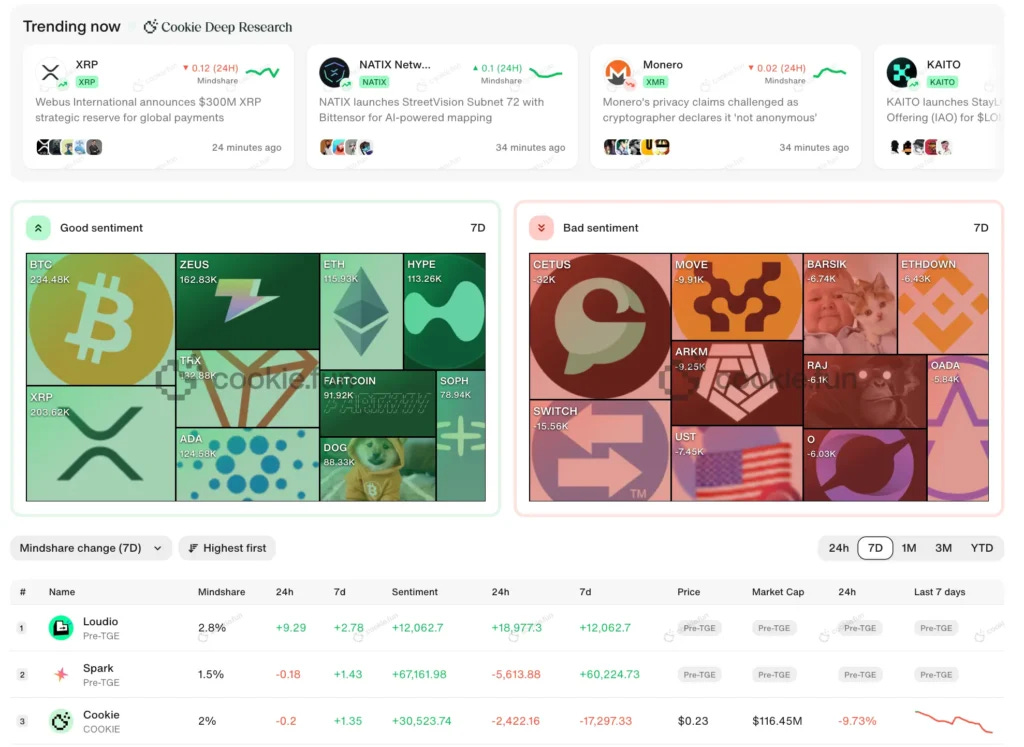
Unlike Kaito, Cookie.fun's homepage not only lists the mindshare of various projects but also summarizes which projects the current market is optimistic or pessimistic about. It then uses Cookie Deep Research to comprehensively analyze popular projects in the market.
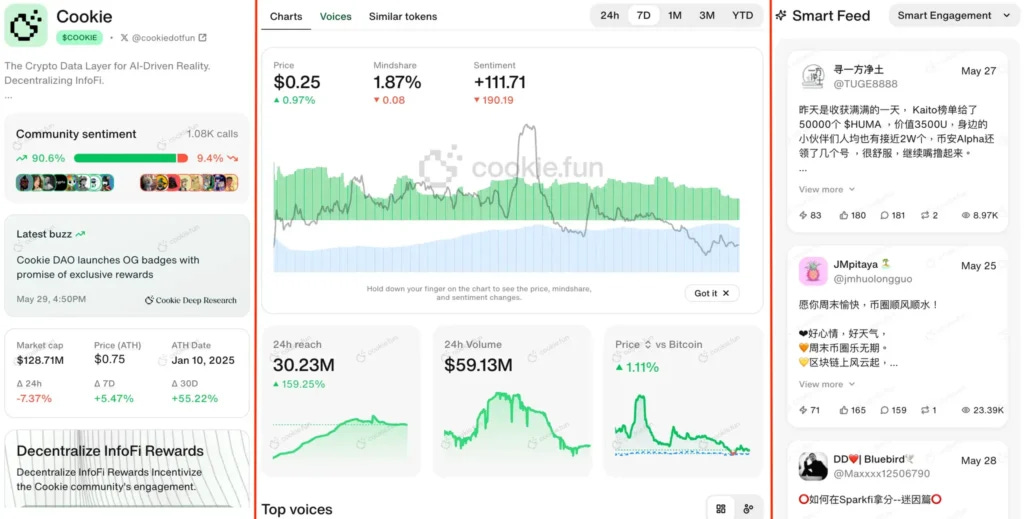
When we enter a token's panel, its page is divided into three sections from left to right:
Basic Token Information: Includes the project's X account, official accounts, community sentiment, and price changes.
Visualized Data: Cookie.fun integrates three indicators—"Price," "Community Discussion Volume," and "Community Sentiment"—into a single chart, allowing users to view the changes in all three at a glance. Additionally, the "Voice" page shows which KOLs are actively discussing $COOKIE in the community, and users can find information on tokens similar to $COOKIE in "Similar Token."
Community Posts: On the far right of the panel, Cookie.fun automatically organizes the most valuable X posts for user reference. Users can also choose to view tweets with optimistic or pessimistic views on $COOKIE to gain a more comprehensive understanding of the community's thoughts on the token.
However, Cookie.fun has not yet established a complete scoring system, unlike Kaito, which uses "Yap" to evaluate users' community contributions and influence.
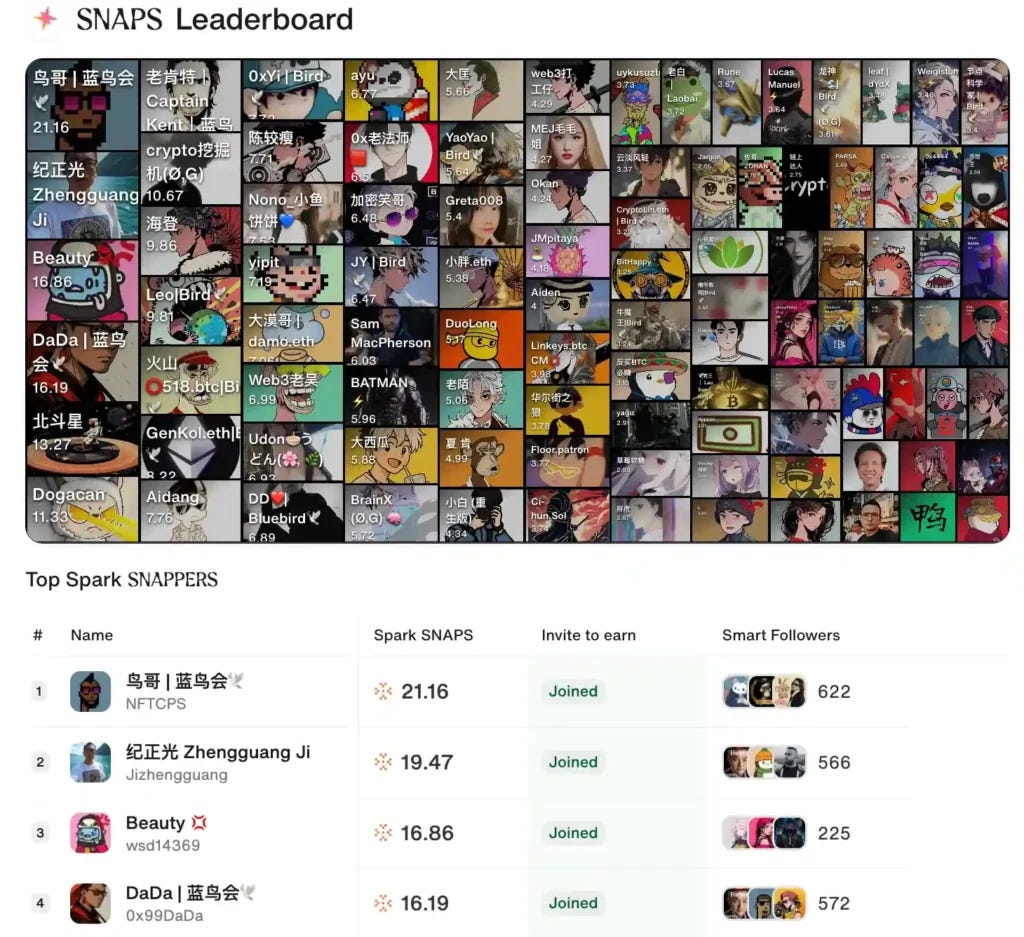
To address this, Cookie.fun has partnered with Spark Protocol, a lending protocol under Sky (formerly MakerDAO), to launch its first Snap event. The gameplay is similar to Kaito, where users earn Snap points based on their interaction activity with Spark on X.
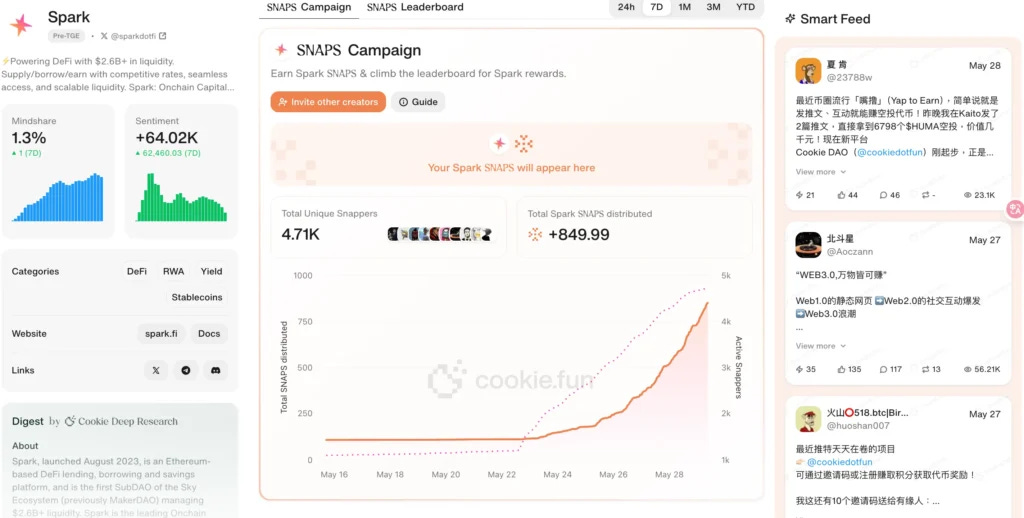
Since Spark has not yet issued its token, there is no token information available. Users can see how many people are currently participating in the event, the contribution leaderboard for each account, and the total amount of Snap points distributed so far.
Based on my experience using it over the past few days, Cookie.fun has several advantages over Kaito:
Information Richness: It provides multiple reference indicators like mindshare, price, sentiment, and tweets, and tracks many more tokens and projects than Kaito. Users can effectively use the search function to proactively find information on projects of interest.
Free Access to Advanced Features and Information: Most of the advanced information on Cookie.fun is free. Only the upcoming Cookie Deep Research will require holding 100,000 $COOKIE to unlock, which is much more accessible compared to Kaito.
Algorithmic Differences: While the gameplay is similar, Cookie.fun's determination of Smart Follower and community contribution differs from Kaito. This not only prevents the InfoFi market from becoming a monologue but also offers a new participation opportunity for users who missed out on Kaito.
Galxe Starboard: A Brand Upgrade for Quest Platforms
If you're an airdrop farmer, you're probably quite familiar with quest platforms like Galxe. For a long time, many projects loved to launch various quests on Galxe for users to participate in, dangling airdrop rewards. Because participation was simple and some projects were quite generous with their airdrops, it became one of the main ways for retail users to "ape in" (farm for free).
However, this good fortune didn't last. As airdrop farming became increasingly systematized, coupled with some projects' delays in airdrops and inconsistent promised airdrop ratios, platforms like Galxe gradually lost user trust, and projects reduced the frequency of promoting themselves through Galxe quests.
Nevertheless, at its core, Galxe was one of the first platforms to gamify user social contributions (likes, comments, and reposts). However, its low barrier to entry made it unable to differentiate varying levels of user participation or detect bots, thereby diluting the value of its points.
InfoFi, by combining AI and blockchain technology, has successfully financialized complex information content, which perfectly addresses Galxe's pain points. Galxe seized this opportunity to collaborate with 14 blue-chip projects, including Sui, Plume, and 0G, to launch Starboard—an InfoFi platform that integrates quest points, on-chain data, and social contributions.
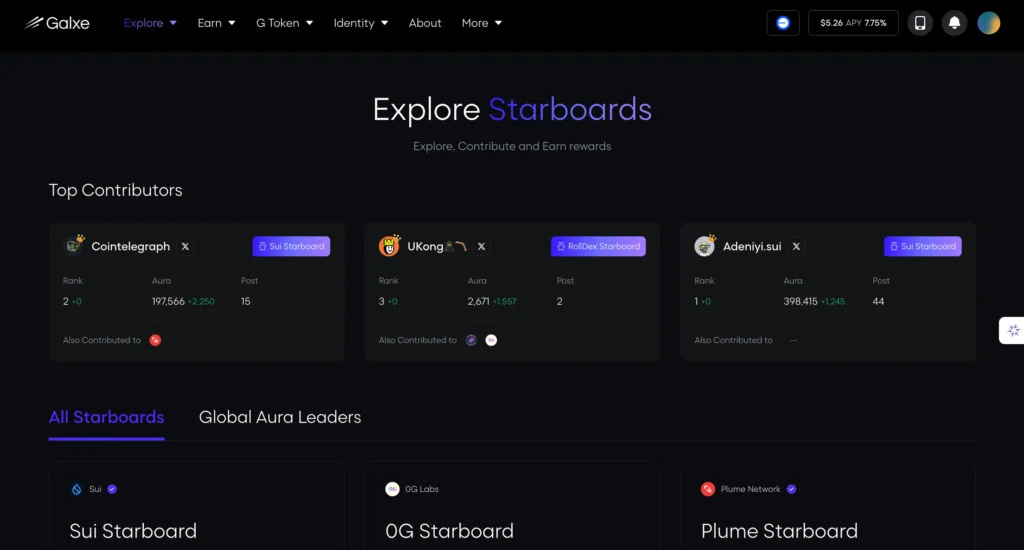
Users can create project-related content on X to accumulate Aura points. Compared to Kaito and Cookie.fun, Galxe Starboard's interface is currently relatively simple, offering only individual leaderboards, X posts, and an overall ranking for these 14 projects, with no other additional features.
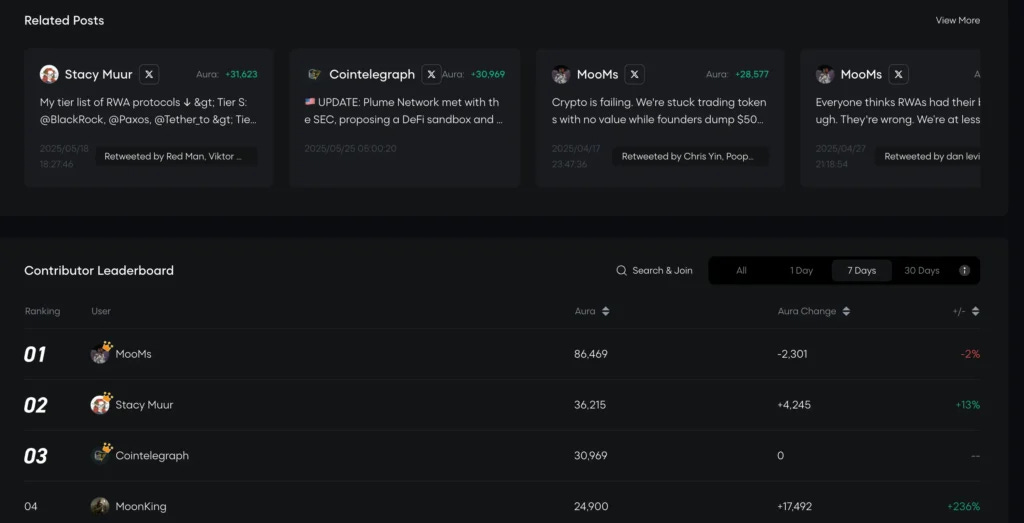
In terms of information integration, users can't discover current market hotspots from Galxe Starboard. Instead, project teams can use Starboard to manage quests, view loyalty points, and track social contributions all on one page, helping them determine token reward allocation. Its design is more geared towards ease of management for project teams, with less focus on user-facing playability.
However, Galxe Starboard's advantage lies in the fact that project teams' reward distribution might not solely rely on the level of social contribution. Loyalty points accumulated through Galxe quests will also hold some weight. While the actual distribution and calculation methods still depend on individual projects, it has the potential to offer a more comprehensive and objective way to measure user participation.
Comparison of Kaito, Cookie.fun, and Galxe Starboard
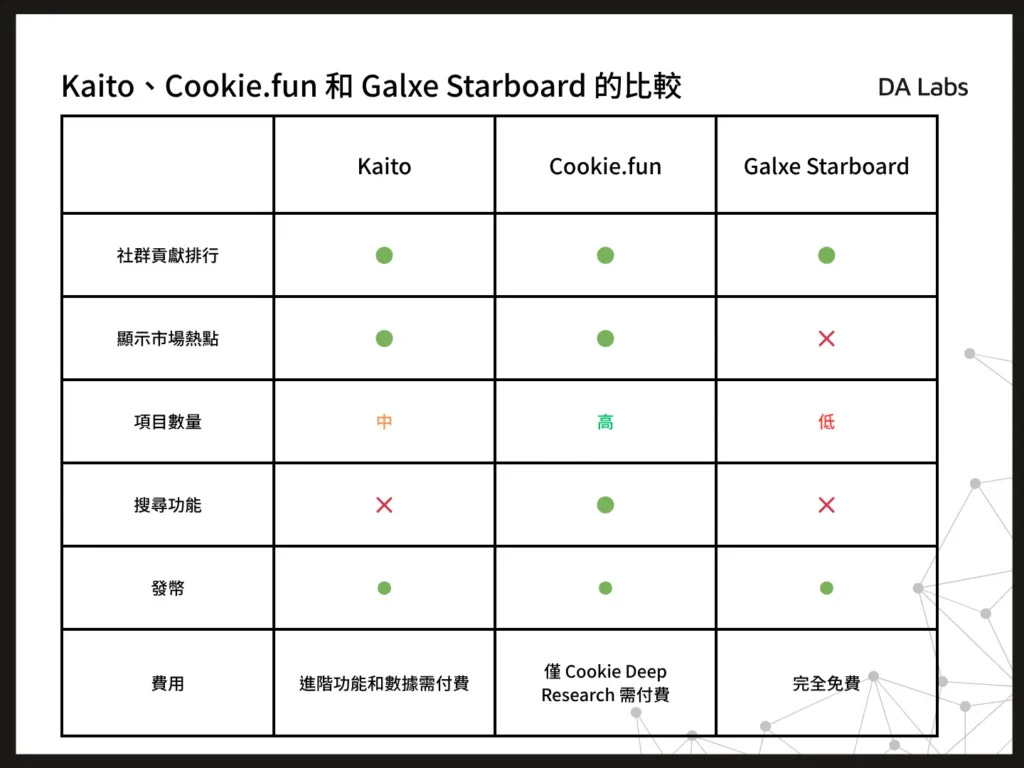
From a practical perspective, Galxe Starboard has been launched and developed for a relatively short time, and its functionality clearly can't compare to the other two. Cookie.fun, on the other hand, offers the most comprehensive information integration, with most features being free. Builders focused on smaller projects can also use its search function to check their community contributions, satisfying the needs of most general users.
However, because Cookie.fun also tracks mainstream cryptocurrencies like Bitcoin, Ethereum, and SOL, it introduces too much noise for users looking to track early Alpha or scout un-issued token projects. In this scenario, Kaito's Pre-TGE Arena can effectively help "degen" players discover high-quality early projects within the community.
Furthermore, Kaito has already generated significant wealth effects. Yappers have not only received airdrops from multiple projects, but users staking $KAITO can also receive token revenue from project buybacks. Recently, a portion of Huma Finance's airdrop, along with $LOUD, a meme coin project built on Kaito, has also committed to distributing 18% of its transaction fee revenue to $KAITO stakers, significantly increasing the holding value of $KAITO.
Kaito's monetization capability has been market-validated, building a deep moat around it. This is also where Cookie.fun and Galxe Starboard still need to prove themselves. If they cannot generate a comparable wealth effect, it will be difficult for them to compete with Kaito, no matter how comprehensive their features.
Extended Thoughts and Conclusion
Cookie.fun and Galxe Starboard, unlike derivative platforms such as LOUD and Ethos, directly compete with Kaito in terms of functionality and gameplay, differing only slightly in their algorithms. For users, having more InfoFi platforms is undoubtedly beneficial. This means that a single post can simultaneously accumulate points on three platforms, significantly increasing potential earnings. Different algorithms also enhance the chance of one's posts being seen on other platforms, preventing the market from being controlled by a single algorithm.
Interestingly, a closer look reveals that the projects currently collaborating with Kaito, Cookie.fun, and Galxe Starboard do not overlap. This indicates that from the perspective of project teams, while Kaito enjoys a first-mover advantage, it is far from monopolizing the InfoFi market. Project teams are still willing to experiment and collaborate with different platforms, which indirectly shows that the competition among InfoFi platforms is intensifying.
If you are a heavy X user, you might already be desensitized to a long string of highly homogeneous posts and tired of the InfoFi gameplay. However, every emerging market inevitably goes through a period of exploration and maturation before reaching maturity. This journey is always full of ups and downs. Taking the time to calmly research will help you avoid missing the next big wave.
Disclaimer
This report is for informational sharing purposes only and does not constitute any form of investment advice or basis for decision-making. The data, analysis, and views cited in this article are based on the author's research and public sources, and may be subject to uncertainty or change at any time. Readers should make investment judgments prudently based on their own circumstances and risk tolerance. For further guidance, it is recommended to seek professional advice.
DA Labs —— Bridge the Fintech Gaps